

The Rules of Dagorhir
The Rules of Dagorhir?
Well known as, The Manual of Arms. This Codified Set of Rules is the foundation of all boffer larps
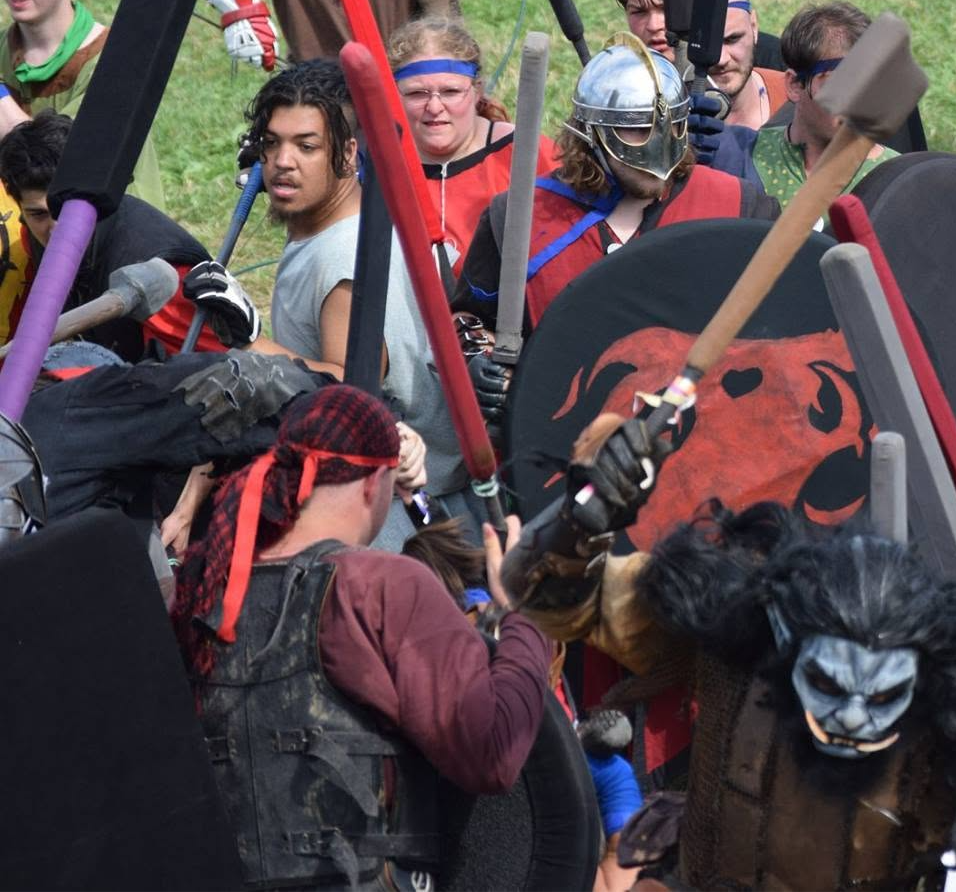
In 1977, a group of friends with a shared passion for medieval history and Tolkien’s fantasy world created a battle game. Drawing inspiration from the Elvish languages of Middle Earth, they named it “Dagorhir,” which translates to “battle lords.” Over time, Dagorhir grew beyond its origins, spreading across the United States and beyond. What began as simple battles evolved into weekend camping trips and eventually into week-long immersive medieval and fantasy experiences, attracting thousands of participants.
Players, known as “Dagorhirrim,” adopt alternate personas for the game. These personas can be as detailed or simple as the participant prefers—some develop intricate backstories and character genealogies, while others choose a new name to use during the game. Personas can hail from any historical period before the widespread use of gunpowder in Europe or from a compatible fantasy setting.
Characters don’t disappear when a player is “killed” in Dagorhir combat. Instead, players remain “dead” for a set duration, depending on the scenario, and then return to the game (“rez”) to fight again in the next stage.
Battle scenarios range widely in format. Some involve single-life combat where the game ends when one team remains standing, while others allow players to rez repeatedly during the scenario until a specific objective is achieved or time runs out. No prior experience in martial arts or medieval combat is required to join.
SEARCH




Manual of Arms
Medieval garb is clothing that helps create the look and feel of a medieval or fantasy setting while avoiding obviously modern styles. You do not need an expensive or historically perfect costume to participate—simple, comfortable clothing that fits the setting is usually enough.
SEARCH

Rule Zero
Dagorhir is a game of honor. Common sense supersedes loopholes. Safety comes first, then playability, then realism. Loopholes will not be considered.

Hit Locations
The body is divided into torso, arms, legs, head and neck, hands, and feet. Torso hits can kill, while arm or leg hits disable that limb. The head and neck are prohibited targets for melee weapons but may be struck by appropriate projectiles.
a) Torso: Shoulders sockets, shoulders, collar bone, chest, stomach, crotch, sides, back, buttocks, and hip sockets.
b) Legs: From the top of the foot (including the ankle) to the torso.
c) Arms: From where the hand meets the wrist to the torso.
d) Head: The Area above the neck.
e) Neck: The area directly below the head and inside the collar bones.
f) Hands: From where the hand meets the wrist to the tips of the fingers.
g) Feet: From where the foot meets the ankle to the tips of the toes.

Taking Wounds
Valid hits to an arm or leg disable that limb, while a valid hit to the torso kills the fighter. Once wounded, the affected limb must immediately be taken out of play and cannot be used again until the fighter is healed or respawns.
a) Dead: go prone (three points of contact, including one elbow) or place a hand on your head. Call “dead” or “down” aloud, then wait for a chance to clear away from combat so you are not in anyone’s way.
b) Lost arm: drop anything in that hand, put the arm behind your back, and do not “magic switch” gear to the other hand. Do not use the lost arm to assist you in any way.
c) Lost leg: kneel on that knee. Crawl, drag the injured leg, or be carried. No hopping. A lunge off the good leg is allowed.
d) A lost limb is treated as not there. Attacks continue through it. Exception: if you are kneeling only on a damaged leg, a hit to that leg doesn't count or pass through. If kneeling on both knees or switching between them then the strike counts..
e) Two lost limbs is death. Disabled limbs do not count toward this.
f) Report armor and wound status honestly. Do not fake death or wounds.
g) Do not kneel in combat; that is how a wounded leg is shown. Crouching is allowed if both knees are off the ground.
h) The dead may not speak to the living except to give a real safety warning.

Blue Weapon Damage
Blue weapons deal hacking or smashing damage. A valid hit to an unarmored torso kills. A hit to an arm or leg causes that limb to be lost.
a) Legal targets: Torso, Arms, and Legs.
b) Damage: Limb Loss, or Death.
c) Armor: Reduces damage by half.

Red Weapon Damage
Red weapons deal heavy hacking or smashing damage when swung with two hands. Such a strike can bypass armor and destroy a shield.
a) Legal targets: Torso, Arms, Legs, and Shields.
b) Damage: Limb Loss, Death, or Shield Broken.
c) Shields: Two shield-breaking hits break a shield.
d) A shield-breaking hit: Call “Red!” as you strike, so the defender knows the intent. Then either (1) you show the body mechanics needed to break a shield, or (2) the blow moves the shield about 4–6 inches. Technique is enough even if the shield does not move; a stronger fighter who already moves the shield does not need the hip mechanics.
e) Armor: Provides no protection.

Green Weapon Damage
Green weapons deal stabbing damage. A valid thrust to the torso kills, while a thrust to an arm or leg causes that limb to become disabled (not loss of limb). One-handed green thrusts do not penetrate armor; a green weapon must be thrust with both hands from the beginning of the thrust to penetrate armor.
a) Legal targets: Torso, Arms, and Legs.
b) Damage: Disabled Limb, or Death.
c) Armor: Reduces one-handed damage to no effect.

Yellow Weapon Damage
Yellow weapons are projectile weapons, including arrows, crossbow bolts, and thrown javelins. A valid hit to the torso or head/neck kills, while a hit to an arm or leg disableds that limb (not loss of limb). Yellow weapons penetrate all armor except head and neck armor.
a) Legal targets: Torso, Arms, Legs, Head, Neck, Hands.
b) Damage: Disabled Limb, or Death.
c) Armor: On head or neck reduces damage to no effect.

White Weapon Damage
White weapons are thrown blunt projectiles, such as foam rocks. They only deal damage when they strike the head, causing death. Hits to the torso, limbs, hands, feet, or neck have no effect, and legal head armor stops the hit. White weapons must be thrown and may never be used as hand-held striking weapons.
a) Legal targets: Head.
b) Damage: Death.
c) Armor: Reduces damage to no effect.

General Weapon Combat
These rules cover the basic standards that apply during combat, including legal strikes, valid targets, projectile ownership, worn gear, and anvilling.
A Legal Strike
a) All hits must be from the striking surface to deal damage.
b) Melee hits still need force. Taps and glances do not count.
c) Do not strike nonlegal targets. For example, if using a blue sword striking at the hands or head is illegal.
d) Projectile hits count when the projectile deflects off a legal target. There is no force requirement.
e) Just touching or grabbing the striking surfaces of gear you don't control results in blue or green damage based on the contact and color of the gear.
f) If you strike someone from behind call the color associated with the damage they should take ("Blue!"). Uncalled hits can be missed or mistaken as ally body or equipment contact.
Projectile Ownership
a) You may return fire using projectiles found on the field, but do not take other people’s projectiles out of the immediate area.
Worn Gear
a) Strikes ignore sheathed weapons and other worn objects, including cloaks. If the blow would have hit the fighter without the object present, then it counts.
Anvilling
a) A weapon must intercept a blow before it hits a shield or body. Resting a weapon on a shield or body to soak a hit is not a block. If the blocking weapon is driven back into the shield, that is still a legal block.

General Weapon Construction
These rules cover the basic construction and safety standards that apply to all weapons, including padding, cores, striking surfaces, dimensions, weight, durability, and required safety checks.
Safe Gear
a) It is your responsibility to ensure your gear is within the rules. All gear will be spot checked by the other participants before is can be used in play.
b) Gear used in contact must be safe at full force on an unarmored person.
i) Blade flats, pommels, and hafts must be padded.
Cloth Covers
c) Weapons must have an opaque cloth cover on all striking surfaces. No modern logos, neon colors, see through covers, etc.
d) Javelins must have a yellow cloth cover.
e) Pommels and weapons other than javelins may not have a yellow covering of any kind. Shade variation is not considered, for example gold or mustard are still yellow.
f) Shields must have either an opaque cloth cover or a plasti-dip finish.
Minimum Dimensions
g) Striking surfaces cannot pass more than 0.5″ through a 2.5″ hole when tested in the direction of the strike.
h) Pommels, crossguards, and other non-striking tips cannot pass more than 0.5″ through a 2.0″ hole.
Weapon Cores
j) No metal cores.
k) Wood cores must be fully taped the entire length and circumference.
l) Striking surfaces cannot be below the top of the handle or crossguard, such as pommel spikes.
m) The dead edge of Single-edged weapons must be clearly marked either using tape or cover design. At minimum, a strip of silver tape, at least 1″ wide, and 1/3 the length of the edge or 5" whichever is greater.
n) Weapons that present entanglement issues, use a punching motion, or encurage dangerous play are banned. This list includes but is not limited to: nets, lassos, punji sticks, nunchucks, tonfas, punch daggers, and double-ended weapons (quarter staves, double-ended daggers, etc.).
o) The pommel must be marked with a stripe of the weapon’s class color(s) (usually with tape).
p) Flails can only be One-Handed Weapons, for example there is no such thing as Light or Two-Handed flail.

Light Weapons Combat
Weapons under 18 inches function as very short-range sidearms suited to close fighting, grappling distance, and quick follow-up attacks. Historically, they most closely resemble daggers and large fighting knives rather than swords.
Examples: dagger, knife, hatchet, short mace, sap, etc.
a) Deals Blue damage.
b) One-handed hack or smash.
c) Using with two hands doesn't change damage type.

Light Weapons Construction
Weapons from 12 inches to under 18 inches have no minimum weight or balance requirement, allowing them to be lighter and quicker than standard-length weapons while still meeting all normal padding, striking-surface, and safety requirements.
Examples: dagger, knife, hatchet, short mace, sap, etc.
a) Total length 12″ to under 18″.
b) Striking surface at least 6″ long.
c) Unpadded handle at most 1/3 of total length.
d) May have a green stabbing tip.
e) The pommel must be marked with a blue stripe (usually tape).

One-Handed Weapons Combat
One-handed weapons are the standard close-combat weapons of Dagorhir, including swords, axes, maces, and similar arms. They are used for hacking or smashing attacks and offer a balance of reach, speed, and control while leaving the other hand free for a shield or second weapon.
Examples: sword, axe, mace, hammer, club, cutlass, flail.
a) One-handed swung weapons deal blue damage. (optional tip: green)
b) One-handed hack or smash. Two hands still counts as blue.

One-Handed Weapons Construction
One-handed weapons are at least 12 inches long and under 48 inches, with at least a 6-inch striking surface. Weapons 18 inches or longer must weigh at least 12 ounces and balance above the unpadded handle. They must also meet Dagorhir’s general padding, flex, pommel, and safety requirements.
Examples: sword, axe, mace, hammer, club, cutlass, flail.
a) Total length 18″ to under 48″.
b) Weight at least 12 oz.
c) Must balance above the unpadded handle.
d) Flex no more than 45° in the direction of the strike.
e) Unpadded handle at most 1/3 of total length.
f) Striking surface at least 6″ long.
g) May have a green stabbing tip, except flails.
h) The pommel must be marked with a blue stripe (usually blue tape).
i) A flail chain can be 6″ or less, and fully covered with segmented foam rings.
j) A flail haft end must follows the 2-inch rule.
k) A Flail cannot also be green, they only ever do blue damage.
l) A Flail Ball must be at least 16″ around at its narrowest, and at least 4 oz.

Two-Handed Weapons Combat
Two-handed weapons trade speed and shield use for greater reach and power. When swung with both hands, red weapons can bypass armor and damage shields, making them effective for breaking defensive lines and attacking armored opponents.
Also called: glaive, halberd, longsword, two-handed axe, maul.
a) Two-handed hack or smash.
b) One-handed swing counts as blue.
c) Damage: red (optional tip: green)

Two-Handed Weapons Construction
Two-handed weapons are long melee weapons built for two-handed use. They must meet Dagorhir’s required minimum length, weight, balance, padding, striking-surface, flex, and safety standards, with additional construction demands because of the greater force generated by their size and leverage.
Also called: glaive, halberd, longsword, two-handed axe, maul
a) Total length 48″ to under 80″.
b) Weight at least 24 oz.
c) Unpadded handle at most 1/3 of total length, and at most 30″.
d) Must balance above the handle.
e) Flex no more than 45° in the direction of the strike.
f) May have a green stabbing tip.
g) The pommel must be marked with a red stripe (usually red tape).

Stabbing/Thrusting Weapons Combat
Stabbing weapons attack with the point using controlled thrusts rather than swings. They are commonly found on spears, polearms, and thrust-capable swords, providing strong reach and precise attacks against openings in an opponent’s defense.
a) Damage: green
b) Thrust only.
c) Two-handed thrust: both hands on the weapon from the start of the thrust until it hits.
d) One-handed thrust counts as one-handed green, including a sliding or pool-cue thrust.

Stabbing/Thrusting Weapons Construction
Stabbing weapons must have a large, soft, compressible thrusting tip designed to safely absorb direct point-first impacts. The tip must prevent the core from being felt through the padding and remain securely attached during repeated use.
a) Stabbing weapons: spears, sword points, daggers, and stabbing points on pole arms.
b) Thrusting tip cannot pass more than 0.5″ through a 2.5″ hole.
c) Spears: at least 1/3 of the haft padded. Padding may be lighter than on a swung weapon.
d) Spear shaft flex no more than 90°.
e) The pommel must be marked with a green stripe (usually green tape).

Bows & Arrows Combat
Bows provide long-range attacks using yellow projectile damage. Arrows can strike the head and neck as legal targets, making archery effective for attacking exposed opponents and forcing fighters to protect areas that melee weapons cannot legally target.
a) Projectiles shot from bows deal Yellow damage.
b) Arrows are shot from the bow. Half-draw under 20 feet. Must travel the arrow’s own length.
c) The head must strike.
d) Stopped by a shield or legal head armor. Do not catch, bat, or block arrows with anything else. An intentional block with other gear is death.
e) Arrows pass through weapons and damage whatever was behind them.
f) After the path changes on anything else, the arrow is spent.
g) Call “Arrow!” aloud when shooting an unaware player. They take the hit or ask for clarification.
h) A bow may turn aside thrusts. A blue or red hack or smash breaks the bow.
i) You must bring at least two passing arrows to the battlefield to use a bow.

Bows & Arrows Construction
Bows must stay within Dagorhir’s draw-weight limits and may only fire approved padded arrows. Arrows require broad, soft, securely attached heads designed to prevent the shaft from penetrating through the padding, along with safe shafts, nocks, and fletching suitable for battlefield use.
a) Longbow or recurve. Draw weight 35 lbs or less at 28 inches of draw.
b) Shafts over 28″: draw stop between 27″ and 28″ from inside the nock.
c) Striking face at least 2.5″ in all directions and cannot pass more than 0.5″ through a 2.5″ hole. Structural foam at least 2″ where it meets the face.
d) Open-cell foam face. Metal disk at least as hard as a penny (¾″ across, 1/16″ thick) perpendicular at the end of the shaft; golf-tube shafts use a washer larger than the rolled edge.
e) At least two full fletchings and a nock. Wooden shafts fully taped.
f) No masking, packaging, scotch, painter’s, or similar poor-adhesion tapes. Duct tape is allowed.
g) Head stays put: no easy twist, plunge, or wobble. Striking surface is tape-free.
h) Aluminum arrow shafts may have metal cores.

Crossbows & Bolts Combat
Crossbows provide short-range yellow projectile attacks using mechanically drawn bolts. They allow the user to hold the weapon ready without maintaining the draw by hand and are effective for accurate ranged attacks against exposed targets.
a) Projectiles shot from crossbows deal Yellow damage.
b) Bolts are shot from the crossbow. Half-draw under 20 feet. Must travel the bolt’s own length.
c) Stopped by a shield or legal head armor. Do not catch, bat, or block bolts with anything else. An intentional block with other gear is death.
d) Bolts pass through weapons and damage whatever was behind them.
e) Call “Bolt!” aloud when shooting an unaware player. They take the hit or ask for clarification.
f) A blue or red hack or smash breaks the crossbow.
g) Unattended crossbows cannot remain under tension.

Crossbows & Bolts Construction
A mechanically drawn ranged weapon limited to 450 inch-pounds of draw, measured as draw weight multiplied by power stroke. It fires specially padded bolts with broad, soft striking heads designed for safe battlefield use. Bolts count as yellow projectile weapons and cannot be used as hand weapons.
a) Non-compound crossbow. Draw no more than 450 inch-pounds. Inch-pounds = draw weight at full draw × power stroke in inches. Power stroke is the distance the string travels from rest (uncocked) to full cock.
b) Bolt shaft 18″ or less. A draw stop does not count toward that length.
c) Crossbow nock: half-moon, flat, capture, or multi-groove.
d) Striking face at least 2.5″ in all directions and cannot pass more than 0.5″ through a 2.5″ hole. Open-cell foam, tape-free.
e) Penny or equal metal blunt perpendicular at the end of the shaft. At least two full flexible fletchings.
f) Head stays put if twisted or pulled. Wooden shafts fully taped. Aluminum bolt shafts may have metal cores.
g) Modular heads: semi-permanent join (screw, epoxy, glue, or strapping tape) and tape as a second hold.

Javelins Combat
Javelins are versatile yellow projectile weapons that can be thrown at range and used for controlled thrusting in close combat. They combine reach and mobility, making them useful for both skirmishing and finishing attacks.
a) Damage: yellow when thrown, green when held
b) Thrown: half force under 20 feet. Must travel its own length. Counts as yellow.
c) Held: thrust as a green weapon.
d) Any block that stops the head counts, including catching the shaft or blocking with a weapon.

Javelins Construction
Javelins are lightweight, fully padded throwing spears built with a broad, soft striking head and safe shaft padding. They must meet Dagorhir’s size, weight, padding, and flex requirements for both thrown use and close-range thrusting.
a) Length 4 to 7 feet. Weight 1.5 pounds or less.
b) Padded along the entire length.
c) Head at least 3.5″ in all directions and cannot pass more than 0.5″ through a 3.5″ hole. Structural foam at least 3″ where it meets the face.
d) Yellow cover on the head (not the pommel).
e) Shaft flex no more than 90°.
f) Must also pass green weapon standards.

Rocks Combat
Rocks are white projectile weapons thrown by hand. They deal damage only when they strike the head, making them a specialized ranged weapon for targeting an otherwise protected combat zone.
a) Rocks do white damage
b) Rocks must be thrown.
c) Rocks must travel a minimum of 36" inches to count as a strike.

Rocks Construction
Rocks are soft foam projectiles with no rigid core. They must be large, compressible, and safely constructed so they can be thrown at the head without creating a hard or concentrated impact point.
a) Foam, at least 4″ in diameter, with as little tape as possible.
b) Weight 1.5 pounds or less.
c) Passes the 2.5-inch hole test in every aspect of construction.

Shields in Combat
Shields are defensive tools used to block weapon strikes and projectiles, protect vulnerable strike zones, and control space in close combat. They can also be used for legal shield checks, bashes, and other controlled contact.
a) Use or wear it in any manner: arm, held punch style, worn on the back back, propped to one the side, and so on.
b) May only use one shield at a time.
c) When broken, drop it at once. Hits that land before it is dropped count as if the shield were gone.
d) See Bashing, checking, and kicking under Body Contact for more info.
e) Shields cannot also be weapons.

Shield Construction
Shields must be built with safe, padded edges and surfaces suitable for repeated battlefield contact. Rigid cores must be fully protected so no hard or sharp areas can injure another fighter, and the shield must meet Dagorhir’s size, padding, and safety requirements.
a) Minimum diameter 12″.
b) Maximum height up to the distance from the wielder’s chin to their ankles.
c) Maximum width up to 36".
d) Front and all edges padded.
e) Any hardware on the inside such as bolts or handles should not protrude more 0.5".
f) Must have a handle and/or arm-straps so it can be used safetly.
g) Cloth cover, or a non-latex soft plastic sealant such as Plasti-dip.

Armor General Rules
All armor types provide the same protection. How a hit interacts with armor is under Damage and Wounds.
a) Armor is never destroyed. It only changes how a hit deals damage.
b) Armor only Protects the area it covers. A hit to both an armor and unarmored part of the same zone (including gaps) is taken on the unarmored part. Gaps of ¾″ or less are ignored.
c) Armor must be built and recognizable as armor, worn as intended, and kept visible.
d) Same garb limits as clothing: no modern look or symbols.
e) No visible plastic or other non-period materials.
f) No spikes or points. Edges must be blunted.
g) There can be no projections over ½″.
h) The armor must not catch fingers.

Leather Armor Construction
Flexible armor made from thick or hardened leather. It provides lightweight protection against cuts, scrapes, and impacts while preserving good mobility, making it comfortable and practical for extended wear
a) Examples: cuirass, vambraces, greaves, spaulders, leather cap, breastplate, backplate, gorget.
b) Leather at least 3/16″ (12 oz). Thin layers may be stacked to reach that thickness.

Studded, Scale, Brigandine Armor Construction
Reinforced armor built from leather or fabric combined with metal studs, scales, or plates. These styles provide a balance between flexibility and rigid protection, helping spread impacts while allowing more freedom of movement than full plate armor.
a) Examples: studded leather, scale shirt, brigandine, rings on a leather backing.
b) Metal studs, scales, brigandine plates, or rings on a backing that is not itself armor.
c) Metal pieces no more than ¾″ apart. A penny must not sit flat on the backing without touching metal.

Chainmail Armor Construction
Flexible armor made from interlocking metal rings. It provides strong protection against cuts and helps distribute the force of impacts while allowing excellent freedom of movement. Its main drawbacks are weight and less protection against concentrated blunt force compared with rigid plate armor.
a) Examples: hauberk, coif, mail sleeves, chausses.
b) Interconnected metal rings only.
c) A ⅜″ rod must not pass through the weave.
d) Allowed Metals: iron, steel, bronze, brass, copper.
e) Minimum ring thickness 19 gauge (0.9mm).
f) Maximum thickness 1/8″.

Plate Armor Construction
Rigid armor made from shaped metal plates worn over the body to protect against blows, cuts, and impacts. It can be made as a full suit or as individual pieces covering areas such as the chest, shoulders, arms, legs, or head.
a) Examples: breastplate, backplate, gorget, greaves, vambraces.
b) Allowed Metals: iron, steel, bronze, brass, copper.
c) Minimum thickness of 19 awg (0.035" / 0.9mm).
d) Maximum thickness of 9 awg (0.114″ / 2.91mm).
e) Not allowed on hands, knees, or elbows.

Head & Neck Armor Construction
Head and neck armor protects against projectile hits, rather than functioning like normal torso or limb armor. A legal helmet or coif covering the head or neck causes yellow and white projectile hits to have no effect.
a) Examples: nasal helm, spangenhelm, kettle hat, great helm, coif.
b) Allowed Metals: iron, steel, bronze, brass, copper, leather.
c) Built as leather, chainmail, or plate, and must pass that type’s construction rules.
d) No non-period grills such as bar grills are not allowed.
e) Stops yellow and white hits to the covered parts of the head and neck zones.

Body Contact - Shield Bash
using your shield to strike an opponent when you begin more than two steps away. That starting distance is what distinguishes a bash from a shield check.
a) A shield strike that starts more than two steps away.
b) Legal targets: front or side of a standing opponent.
c) Never target the head or neck.

Body Contact - Check
Using your shield to strike or displace an opponent from two steps away or closer. That distance is what separates it from a shield bash, which begins from more than two steps away.
a) A shove using your body or shield that starts two steps away or closer.
b) Never target the head or neck.

Body Contact - Shield Kicks
Practically, a shield kick is used to displace, open, or destabilize the shield, not to kick the person holding it. You can plant one foot and use the other foot against the shield to push or knock it aside, potentially creating an opening for a weapon strike or forcing the shield bearer off balance.
a) A shove using your body or shield that starts two steps away or closer.
b) Never target the head or neck.

Body Contact - Grapple
Similar to high-school wrestling. No strikes, slams, throws, submissions, joint locks, or nerve holds. Grapple only to safely control or unbalance your opponent.
a) Wrestling to subdue or unbalance. No throws or joint/nerve holds.
b) No punches or kicks except shield kicks.
c) Start from two steps or closer.
d) Fighters carrying a bow or crossbow may not initiate a grapple.
e) Unarmored fighters may initiate against anyone.
f) Armored fighters may initiate only against equal or greater armored opponents, never against someone with lesser armor or unarmored. Rank, lowest to highest: leather; studded, scale, or brigandine; chainmail; plate. Your rank is the highest armor type you are wearing. A leather helm with no heavier armor counts as leather, so you may initiate against leather or higher, but not against an unarmored fighter.

Healing in Combat
A healer restores wounds and broken gear by reciting an approved Healing Poem while in contact with the damaged fighter.
a) Direct physical contact with the injured person for the whole poem.
b) A Poem of Healing must be at least 180 syllables, read or recited aloud. For example, "By the power of God, be healed, rise and fight again." is 13 syllables. So repeating it 14 times comes to 182 total syllables.
c) If contact breaks, or the healer or injured person is engaged in combat, the poem mustr be started from the beginning.
d) When the poem is finished, all wounds are healed and items the wounded fighter is holding are repaired (ie. bow, shield, battle game item).
e) A healer heals another person, not themselves or their own equipment.

Medieval Garb
Garb is the uniform or clothes worn while playing. The outfit should look at home in a medieval fantasy or historical medieval setting.
Garb Rules
a) Minimum Standard: A tunic, trousers, and neutral shoes.
b) No logos, prints, or neon colors.
c) No blue jeans, white shoes, camouflage, military fatigues, visible T-shirts, other obviously modern clothing, and modern hats.
d) No real weapons on the field, even sheathed.
e) No cleats or spikes on footwear.
f) Bare chest is fine where law and event rules allow, the rest of the costume must still meet the minimum standards.
g) Garb that appears to be armor but does not pass armor rules will not be allowed on the field.